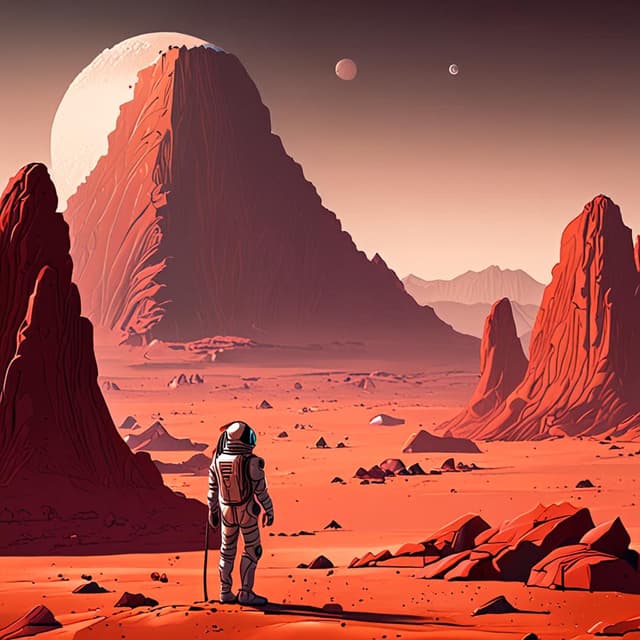
| Genre | |
| Title | A Martian Odyssey |
| Author | Stanley G. Weinbaum |
| Plot summary | A manned expedition to Mars encounters a complex alien civilization and explores the potential for cross-cultural cooperation and mutual understanding. |
| Significance | Considered a landmark work of 1930s science fiction, pioneering imaginative worldbuilding and depiction of alien intelligence. |
| Publication year | 1934 |
"A Martian Odyssey" is a 1934 science fiction novelette by acclaimed author Stanley G. Weinbaum, widely regarded as one of the most influential and accomplished works of speculative fiction in the 1930s. Set in a future where humanity has colonized the Moon and established a permanent research outpost on Mars, the story depicts the first successful manned mission to the Red Planet and the profound first contact between human and Martian civilizations.
The story follows the experiences of Dr. Gilbert Jarvis, a chemist and member of the Mars expedition crew, after his spacecraft crash-lands on the Martian surface. Separated from his team, Jarvis embarks on a harrowing journey across the alien landscape, encountering a series of bizarre and seemingly hostile Martian lifeforms.
Narrowly escaping peril on multiple occasions, Jarvis eventually stumbles upon the advanced underground city of the Martians, a technologically sophisticated yet enigmatic race. Through a mixture of observation, diplomacy and scientific inquiry, Jarvis gradually overcomes his initial distrust and bewilderment to forge a tentative rapport with the Martian leader, a brilliant and benevolent entity known as Tweel.
As Jarvis learns more about Martian culture, biology and psychology, he comes to appreciate the profound differences and profound similarities between the two civilizations. Ultimately, he returns to Earth not only with groundbreaking scientific discoveries, but a deepened sense of kinship and optimism about the prospects for cooperation between humans and Martians.
"A Martian Odyssey" is celebrated for its meticulous scientific extrapolation, innovative worldbuilding, and nuanced exploration of cross-cultural understanding. Weinbaum, a trained chemist, infused the story with cutting-edge scientific ideas about Martian ecology, chemistry, and even the potential for Martian sentience.
The depiction of the Martians as a technologically sophisticated yet fundamentally alien civilization, with their own complex social structures, customs, and modes of cognition, was considered revolutionary at the time. Rather than portraying them as simply monstrous or hostile, Weinbaum crafted the Martians as a fully-realized intelligent species, inviting readers to empathize and engage with their perspective.
This humanistic, open-minded approach to first contact stood in stark contrast to the more xenophobic and militaristic science fiction narratives that were common in the early 20th century. "A Martian Odyssey" was widely praised for its nuanced social commentary, which explored themes of cultural relativism, scientific curiosity, and the universality of the human experience.
The story's influence can be seen in later classic works of science fiction that expanded on the themes of cross-cultural exchange and the challenges of truly comprehending alien intelligence, such as Arthur C. Clarke's "The Sentinel" and Carl Sagan's "Contact". It is widely regarded as a foundational text in the development of "hard" science fiction as a genre focused on rigorous scientific extrapolation.
Today, "A Martian Odyssey" remains a landmark achievement in the annals of speculative fiction, celebrated for its imaginative vision, scientific acumen, and enduring message about the potential for cooperation between disparate civilizations. It continues to captivate and inspire readers, writers, and scientists alike.
